Lot V
Estate & Antique Jewelry
in Delray Beach
Victorian, Deco, and signed pieces.
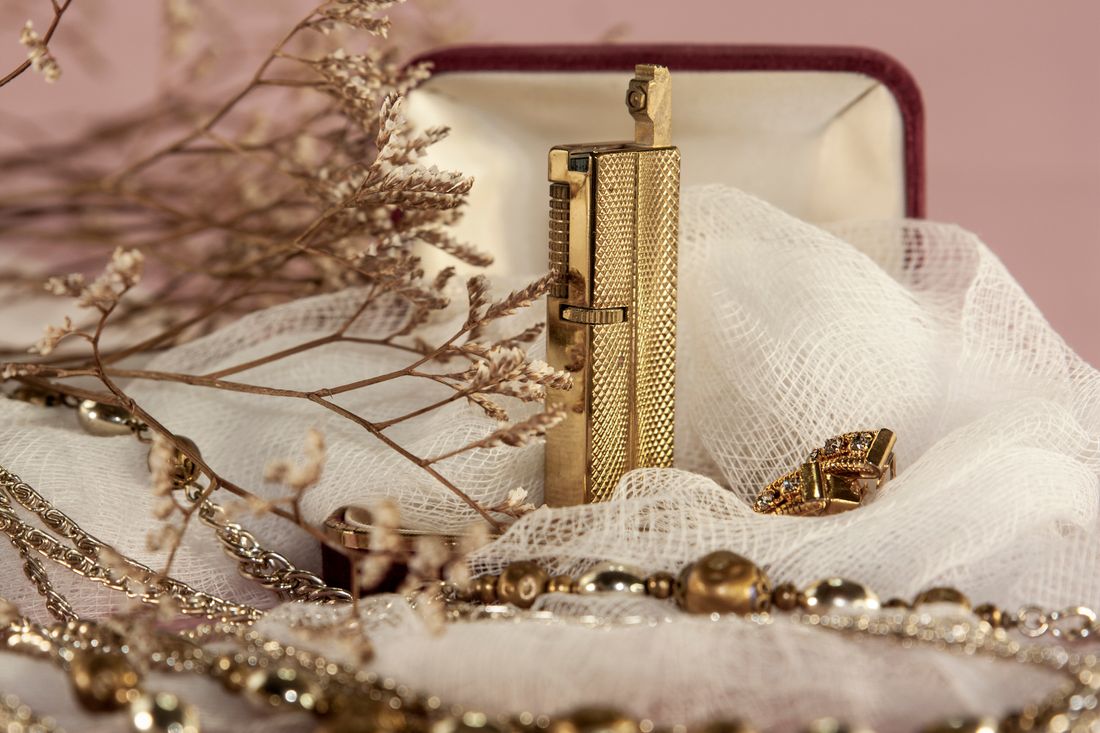
Estate jewelry rarely tells you what it is by looking at it. A tiny stamp inside a shank, the way a stone sits in its setting, the shape of a clasp: these settle the metal, the decade and often the maker before anyone mentions a price. This is how we read a piece at the table in a Delray Beach home, and the laboratory science behind the questions that matter most: is the stone natural, and has it been treated.
What we look for
- Victorian, Edwardian, and Art Deco jewelry
- Signed houses: Cartier, Tiffany, Van Cleef, and others
- Gold, platinum, and gemstone pieces
- Loose diamonds and antique wristwatches
How we read estate jewelry: stamps, periods and signatures
We start with three questions, in this order: what is the metal, when was it made, and who made it. The stamps answer the first almost immediately.
- Gold. Fineness is counted in parts per 1,000. 10K is 417, 14K is 585 (58.5% gold) and 18K is 750 (75%). A European piece may carry only the number. An English piece may carry 9ct, 15ct or 18ct beside assay-office symbols; 15ct is a standard English law dropped in the 1930s, which in itself is a dating clue.
- Platinum. Modern pieces read PT950 or 950 Plat. Older ones are often 900 Plat or Irid. Plat., meaning roughly 90% platinum alloyed with 10% iridium. Platinum is why many pre-war pieces feel heavy for their size.
- Silver. 925 or Sterling means 92.5% silver. English sterling is marked with a small series of punches: the lion passant, a city mark, a date letter and the maker’s mark. Those four tell you where, when and by whom.
- Not solid. GF, RGP, HGE and EP mean gold-filled, rolled gold plate or electroplate. They look like gold and are worth a fraction of it.
Then the period. The dates below follow the standard collector chart used by Kovels and Antique Trader; the characteristics are what we look for in the piece itself:
- Georgian — 1714–1837. Closed-back settings, foil-backed stones, rose-cut diamonds, and hair-work mourning pieces.
- Victorian — 1837–1901. Lockets, snakes, cameos and garnets, with a darker mourning style after 1861.
- Art Nouveau — 1895–1910. Flowing lines, enamel and plique-à-jour.
- Edwardian — 1901–1915. Platinum lacework, milgrain edges and garland motifs.
- Art Deco — 1920s–1930s. Bold geometry, platinum, and stones cut to fit their settings exactly.
- Retro — 1939–1950. Rounded, three-dimensional shapes and big bows and curls in warm rose and yellow gold.
Last, the signature. Cartier, Tiffany & Co. and Van Cleef & Arpels pieces usually carry the house name in clean capitals, and often an individual serial number the house can check against its own records. On French pieces we also read the guarantee marks: the eagle’s head for 18-karat gold (in use since 1838), the dog’s head for platinum, and a lozenge-shaped maker’s punch whose initials change with the workshop head of the period. Fake stamps tend to be blurry, crooked or in the wrong typeface. Kovels makes the same point about copies in general: almost every style has been reproduced. An unmarked piece is not automatically a bad one, since much Georgian and Victorian work predates consistent stamping, but it does mean we test the metal rather than trust it.
The science most buyers (and most dealers) never mention
The hardest question in estate jewelry is no longer “is it real” but “is it natural, and has anyone touched it”. Laboratories answer that with spectroscopy, and some of the published work is public and specific.
Raman tells you the material; photoluminescence tells you the origin. In a 2025 study from the University of Arizona, a team imaged eight cut stones in 3D with multiphoton microscopy: natural diamonds (including one from the Argyle mine in Western Australia), HPHT and CVD lab-grown diamonds, and the look-alikes cubic zirconia and moissanite. They first used Raman spectroscopy to confirm that each stone was the material it was sold as. Then the light signature separated natural from lab-grown. The natural stones glowed blue, between roughly 400 and 450 nm, the signature of the N3 nitrogen defect that the authors call a diagnostic feature of natural diamond. The lab-grown stones fluoresced much further toward the red, in broad bands of about 550–660 nm, with sharp peaks at 575 nm and 637 nm from nitrogen-vacancy centers.
Why a single test never decides it. The same paper notes that heat-treating CVD diamonds to improve clarity can erase much of that fluorescence by removing nitrogen-vacancy centers. The sample was only eight stones, bought from online vendors and confirmed by the authors with Raman. So a lab does not rely on one signal. Related work on lab-grown HPHT stones studies the afterglow after UV excitation: a blue-green phosphorescence commonly seen in near-colorless HPHT diamonds, traced to nitrogen–boron pairs, plus separate orange and red bands. Each of these is one more fingerprint.
Colored stones and treatments. A machine-learning study on blue sapphires drew on 5,515 stones from a gem laboratory’s ten-year archive, measured with UV-visible, infrared and X-ray fluorescence instruments. On 913 held-out stones it detected heat treatment correctly 98.03% of the time. It gave the stone’s origin (Kashmir, Burma, Sri Lanka or Madagascar) correctly 90.69% of the time on 705 stones, and 99.1% when it was only allowed to answer the 38.5% of stones it was most sure about. A human expert needs hours per stone; the model needs under a second. It covers sapphire only, not every gem.
We are not going to set up a spectrometer on your dining table, and we will not pretend to. What this science does is tell us where the real boundaries are. A loupe, a thermal tester, UV light and a scale settle metal and most stones. When a diamond or a colored stone is large enough that natural versus lab-grown, or treated versus untreated, would swing the price, we say so and recommend an independent lab report, because that is the only answer worth paying on.
What actually drives the value
- Maker & signature. A genuine Cartier, Tiffany or Van Cleef & Arpels piece, or a well-documented American or European workshop, is valued as design first and materials second.
- Metal & weight. Gold and platinum set a floor. We weigh and test every piece in front of you, and even a broken chain or an odd earring is worth its metal.
- The stones. Natural, lab-grown or treated is the biggest swing in the whole category. Old-cut diamonds (old mine, old European) have a following of their own and should not be re-cut by well-meaning jewelers.
- Period & design quality. Good Georgian, Edwardian, Art Deco and Retro work is scarce. Fine handwork, such as milgrain, hand engraving and openwork, shows in the back of a piece as well as the front.
- Originality & condition. Replaced stones, new clasps, resized shanks and heavy polishing quietly remove value. Original boxes, papers and a known history add it.
You get the verdict straight, itemized, with the reasoning. If a piece is worth more as a family keepsake than as a sale, we will tell you that too.
Not sure if your piece fits? Text a photo to (561) 465-3536 — we will tell you honestly and for free, with no obligation to sell.
Questions
Selling estate & antique jewelry in Delray Beach
How can I tell if my gold or platinum jewelry is real?
Start with the stamp inside the band or on the clasp: 417, 585 and 750 mean 10K, 14K and 18K; PT950 or 900 Plat means platinum. A stamp is a claim, not proof, and plated pieces can carry misleading marks, so we confirm with an electronic or acid test on the spot, and we weigh the piece as well. Unmarked antique pieces are common and not automatically fake.
Does a Cartier, Tiffany or Van Cleef & Arpels signature matter if I have no box?
Yes, but we verify it. Real signatures are crisp, correctly spaced and in the right typeface for the period, and the house’s own serial number, where present, can be checked against its records. Box and papers add value but are not required. A blurry or crooked stamp is a reason to look closer, not to assume the worst.
Can you tell a natural diamond from a lab-grown one?
Not by eye, and nobody honest can. Laboratories separate them with photoluminescence and related spectroscopy, because natural stones tend to glow blue (the N3 defect) while lab-grown ones fluoresce further into the orange and red. When the difference changes the price meaningfully, we recommend a grading report from an independent lab and will work from that.
Should I clean, polish or repair a piece before selling it?
Please do not. Polishing wears down engraving and softens the crisp edges that identify a period, and replacing a missing stone or clasp can lower value more than it adds. Bring it as it is, along with any box, paperwork or family story that goes with it.
Will you come to the house to look at jewelry in Delray Beach?
Yes. For estate jewelry and full estates we visit the home anywhere in Delray Beach and Palm Beach County, test and weigh each piece in front of you, and pay the same day for what we buy. For a single ring or watch, a few clear photos by text are enough to start.
We also buy