Lot III
Sterling Silver & Silverplate
in Delray Beach
Flatware, hollowware, and tea services.
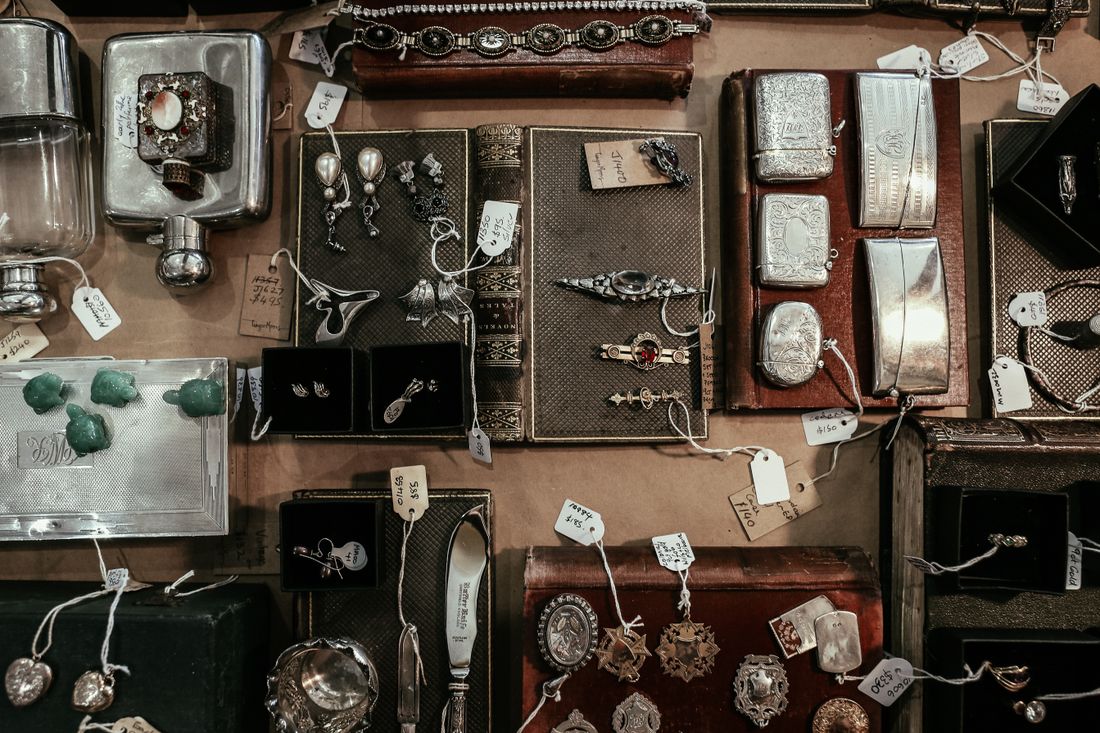
Silver tells you most of what you need to know from the underside. A few tiny punches, a word like “sterling,” or the absence of any mark at all can separate a family heirloom from a thin coat of plate over base metal. Before we talk price in a Delray Beach dining room, we read those marks the way a hallmark reference does — and we weigh them against the object itself. Here is the field knowledge we bring to the table, so you can see exactly what we are looking at.
What we look for
- Full and partial flatware services
- Hollowware: trays, bowls, candelabra, tea sets
- Tiffany, Gorham, Reed & Barton, and English hallmarks
- Sterling and quality silverplate
How to read silver marks — the standards and hallmarks we check first
Every silver appraisal starts with one question: how much of this object is actually silver? Marks answer it. The foundation is the sterling standard: 92.5% silver (fineness .925), with the remaining 7.5% normally copper for strength. When you see “sterling,” “925,” or an English lion on the underside, that is the claim being made.
The mark systems differ by country, and mixing them up is the most common mistake we see:
- English sterling — a full hallmark of usually four or five small punches: a standing lion (the “lion passant”) for sterling quality, a town mark for the assay office (a leopard’s head for London, an anchor for Birmingham), a date letter that changes each year, and the maker’s mark. Between 1784 and 1890 a sovereign’s-head duty mark was added as well.
- Britannia silver — a higher 95.84% standard, required for a short stretch between 1697 and 1720; the figure of Britannia replaces the lion.
- American silver — usually a single maker’s name or trademark plus “sterling” or “925”; a lone mark generally points to American manufacture. Before the early 1800s most American silver was made one piece at a time by individual silversmiths; by the late 1800s it was mass-produced by large firms such as Gorham, Tiffany & Co. and Reed & Barton, and marks became the way to tell who made what.
- Coin silver — roughly 90% silver (.900), the common American standard before sterling took over in the mid-1800s. It is often stamped with just a name, “COIN” or “PURE COIN.”
A few cautions we apply on every visit. Some early marks are pseudo-hallmarks — stars, anchors, shields and tiny lion-like stamps that makers used to imitate English marks; they look official but are not assay marks. An assay stamp (a standard or origin) is not the same as a maker’s mark (who made it), so we read both. And no mark at all does not mean “not silver” — nor does a mark guarantee that the whole piece is solid.
That last point is where plate comes in. Sheffield plate — sheets of silver fused onto copper by rolling, developed in the mid-1700s — was largely replaced by electroplate from the 1840s. Marks like EPNS (electroplated nickel silver), EPBM, “quadruple plate,” or “A1” mean silver over base metal; “nickel silver” itself contains no silver at all. On worn Sheffield plate you can often see a pinkish line of copper at the edges; on electroplate, wear shows up first on high points and rims.
The science most buyers (and most dealers) never mention
This is where we go beyond a loupe and a magnet. Museums and archaeometry labs test silver with X-ray fluorescence (XRF) — a beam of X-rays hits the surface, and the metal answers back with a spectrum that reveals which elements are present, without cutting, scraping or acid. It is the same non-destructive logic that underlies the handheld analyzers dealers now use.
But a 2023 laboratory study from the National Centre for Nuclear Research in Poland (Gójska and colleagues, posted on arXiv and accepted by the journal Measurement) shows exactly where XRF can mislead you — and how to read it properly. They built copper samples coated with silver layers from 4.9 up to 55.9 micrometres thick, tested real silver–copper alloys (90/10, 80/20 and 75/25 silver to copper), and modelled the physics with simulation. Three findings matter for anyone buying or selling silver:
- The instrument sees only the skin. The X-rays used can reach about 100 microns into the metal, but the signal that makes it back to the detector comes from only a few tens of microns or less. Copper’s signal is almost completely blocked once silver on top exceeds about 20 microns; at 55 microns, only 0.02% of it gets through. The authors’ conclusion is blunt: a non-destructive reading of an old silver object is really a reading of its surface, not its bulk.
- A silver-rich surface is not proof of a silver-rich object. Old silver–copper alloys can end up with a surface richer in silver than the metal underneath — through deliberate finishing, copper leached out by acid baths, segregation during casting or annealing, or corrosion. That is why we treat a single analyzer reading as evidence, not a verdict.
- There is a tell for “layer” versus “alloy.” By comparing two silver X-ray lines (the ratio of Kβ to Kα intensity), the team found that a coated sample reads lower than pure silver, while a true silver–copper alloy reads higher and climbs as the silver content falls. Where the coating was thin, the method could estimate its thickness to within about 1% for 4.9- and 10.2-micron layers (11% off at 15 microns, and unusable above roughly 20).
You do not need a synchrotron to sell a tea service. But this is why we cross-check marks, weight, construction and wear together — and why we never price a piece on a single number. The same idea explains tarnish: it is silver sulfide (Ag₂S), a thin dark film formed when silver reacts with sulfur compounds in humid air. In South Florida that happens fast, and it is only on the surface. Tarnish alone does not lower the value of good silver — but aggressive polishing, which removes a little metal every time, can.
What actually drives the value
- Weight and purity first. Silver is priced by the troy ounce (31.1035 grams). Sterling is 92.5% pure, so a piece’s melt value is its weight, times .925, times the day’s silver price. That sets the floor — and for plain, damaged or incomplete items, it is often the answer. Beware weighted sterling: candlesticks, knife handles and some bases are hollow shells filled with cement or pitch, so the scale overstates the silver.
- Maker and line. Names like Tiffany & Co., Gorham, Reed & Barton, Georg Jensen and good English makers can bring far more than melt. Gorham’s Martelé line, for example, was made to a higher .950 standard and is collected as art, not scrap.
- Form and pattern. Hollowware (teapots, trays, pitchers, bowls) usually outranks flatware. For flatware, the pattern name matters, and a complete service with its serving pieces beats a loose handful.
- Age and rarity. Early American and good Georgian English silver is scarce; most of what turns up locally is late-nineteenth- and twentieth-century sterling, which we also buy — fairly, for what it is.
- Condition and originality. Dents, repairs, monograms engraved later, and heavy polishing all subtract. A soft, honest patina is not a flaw.
- Silverplate, honestly. Most plain silverplate carries modest value, and we will say so. A fine Sheffield-plate or important maker’s piece is another matter, which is why it is worth a photo before you discard anything.
Whatever the verdict, you hear it straight — including when a piece is worth more to your family than to the market.
Not sure if your piece fits? Text a photo to (561) 465-3536 — we will tell you honestly and for free, with no obligation to sell.
Questions
Selling sterling silver & silverplate in Delray Beach
How can I tell if my silver is sterling or just silverplate?
Look on the underside for “sterling,” “925,” or an English lion; those point to solid silver at 92.5%. Marks such as EPNS, “quadruple plate,” “A1” or a brand name with no purity mark usually mean plate over base metal. Worn spots showing yellow or pinkish metal underneath are another sign. If you are unsure, send us a photo of the marks and we will read them.
Is tarnished silver worth less?
Not by itself. Tarnish is a thin surface film of silver sulfide, and it forms quickly in Florida’s humidity. Please do not polish aggressively or strip an old finish before you call — heavy polishing removes silver and can lower the value of a collectible piece. Bring it as it is.
Do you buy silver by weight, or by maker and pattern?
Both, depending on the piece. Plain, damaged or incomplete items are valued largely on silver content (weight times .925 for sterling). Pieces by sought-after makers, in desirable patterns, or with age and rarity can be worth well above melt, so we evaluate each one individually and explain how we got to the number.
Will you buy a silver set that is missing pieces or has a monogram?
Yes. A monogram or a few missing pieces lowers the premium, not our interest — we still buy incomplete flatware, mismatched hollowware and monogrammed pieces, and we pay for what they are.
Can you come to my home in Delray Beach to look at silver?
Yes. We visit homes across Delray Beach and Palm Beach County, examine each piece on the spot, and pay the same day for what we buy. For a single item or a few pieces, a text photo of the item and its underside marks is enough to start.
We also buy